
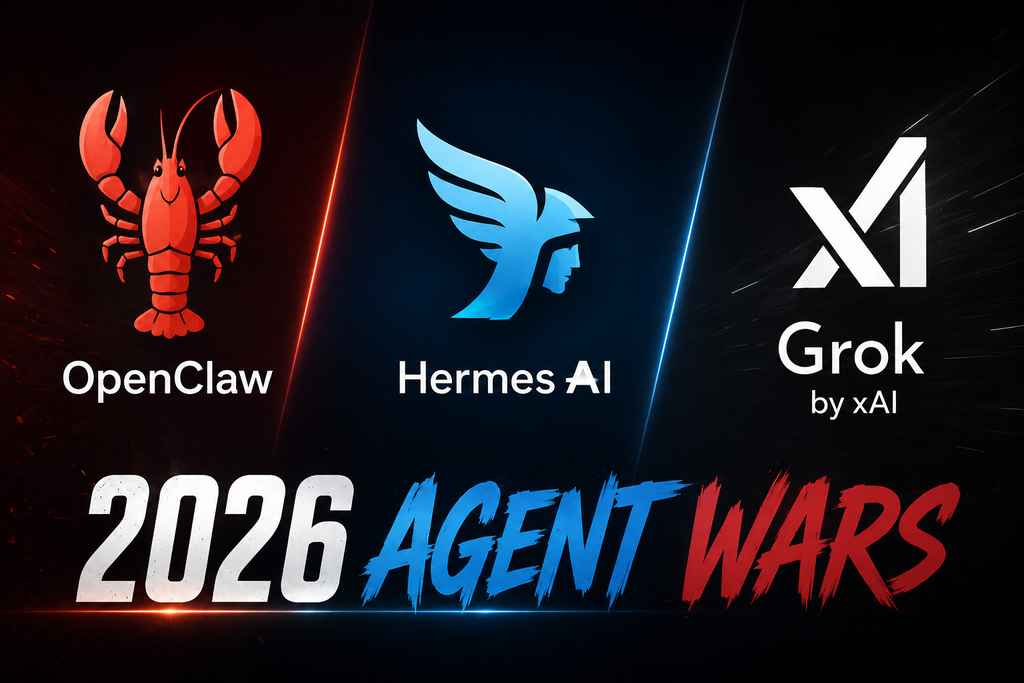
The AI agent race just got serious.
In 2026 we’re no longer talking about chatbots that answer questions. We’re talking about AI Agents that actually do things — manage your files, talk to your apps, remember context across weeks, and run while you sleep.
Three names keep coming up in every serious conversation:
- OpenClaw 🦞
- Hermes Agent
- Grok Bot
Here’s a clear, no-hype breakdown of what each one actually is and who they’re best for.
1. OpenClaw – The Open-Source Gateway King
OpenClaw is the most popular open-source personal AI agent right now. It started life as Clawdbot / Moltbot and exploded in early 2026.
What makes it special:
- Runs on your hardware
- Connects to almost every messaging platform (WhatsApp, Telegram, Discord, Slack, iMessage, Signal, etc.)
- Huge skill ecosystem (ClawHub)
- Strong multi-user and team support
- Fully open-source under the MIT license and now under an independent foundation
Best for: People who want maximum channel coverage and like the idea of a local, controllable AI that lives in their chats.
Trade-off: You manage the server/security yourself. It’s powerful, but you need to treat permissions carefully.
2. Hermes Agent – The Self-Improving Specialist
Built by Nous Research, Hermes Agent takes a different philosophy. Instead of just executing tasks, it learns from them.
Key strengths:
- Built-in learning loop — it creates and improves its own skills over time
- Excellent long-term memory system
- Very strong at multi-step, complex work
- Model-agnostic (works with Grok, Claude, GPT, local models, etc.)
- Cleaner and more stable on many complex workflows according to early users
Best for: Solo power users and researchers who want an agent that gets better the longer they use it.
Trade-off: Slightly narrower channel support compared to OpenClaw (though still covers the major ones).
3. Grok Bot – The Managed Cloud Option
Grok Bot is xAI’s managed agent offering. You don’t run a server — xAI gives you a cloud computer that stays online 24/7.
What stands out:
- Zero server management
- Native Grok models (including the latest reasoning versions)
- Works while your laptop is closed
- Clean integration with X/Grok ecosystem
- Easiest onboarding of the three for non-technical users
Best for: People who already have SuperGrok / X Premium and just want something that works without babysitting a VPS.
Trade-off: Less control and less open than the other two. You’re renting, not owning.
Quick Comparison Table
| Feature | OpenClaw | Hermes Agent | Grok Bot |
|---|---|---|---|
| Hosting | Self-hosted | Self-hosted | Fully managed |
| Open Source | Yes (MIT) | Yes (MIT) | No |
| Self-Improving | Limited | Strong | Moderate |
| Channel Support | Excellent | Good | Good (via connectors) |
| Setup Difficulty | Medium | Medium | Easy |
| Best For | Teams & multi-channel | Solo + learning | Zero-maintenance users |
Which One Should You Choose?
- Want maximum freedom + many chat apps → OpenClaw
- Want an agent that gets smarter over time → Hermes Agent
- Want zero ops and already use Grok → Grok Bot
Many advanced users actually run two of them. OpenClaw or Hermes as the local control plane, and Grok Bot as the always-on cloud teammate.
Final Thought
We’re still in the early days of real AI agents. OpenClaw brought the lobster energy and mass adoption. Hermes brought the self-improving intelligence. Grok Bot brought the “just works” cloud experience.
The interesting part isn’t which one wins — it’s that for the first time, normal people can actually own (or rent) an AI that does work instead of just talking about it.
Which one are you running right now? Drop it in the comments — I’m genuinely curious.nd I’ll adjust it.